


Maui’s health care shortages are not abstract policy debates. They show up in real and painful ways: dialysis patients scheduled at 10 or 11 at night, months-long waits for cancer biopsies, surgeons operating late at night or on weekends because no operating rooms are available, and families being told they must leave the island for care that should exist here.
These conditions are not the result of geography or bad luck. They are the predictable outcome of policy choices—specifically consolidation, supply-restricting regulation, low reimbursement rates in a high-cost state, and market structures that protect large institutions while limiting competition.
On Maui, patients experience this every day and pay the price for these policy choices.
Dialysis chairs are so limited that patients must come late at night simply to receive life-sustaining treatment three times a week. People with suspicious breast findings are told the earliest biopsy appointment may be many months away. Even patients with acute psychiatric needs can wait months to be seen, if they are seen at all. Families believe they “have insurance,” only to discover they are trapped in medically unsafe queues.
The human toll — on health, families and livelihoods — is real and growing.
To understand why this is happening, we need to be clear about the forces shaping Maui’s — and Hawaiʻi’s — health care system.
A System Designed To Restrict Supply
At the center of this crisis are three forces working together: Certificate of Need laws, increasing consolidation of hospitals and insurers, and the emergence of a two-tier health care system that leaves Maui residents with fewer choices and longer waits.
In theory, Certificate of Need laws are intended to prevent unnecessary duplication of services and protect communities from low-quality providers. In practice on Maui, Certificate of Need has restricted the development of imaging centers, dialysis facilities, surgical centers and operating rooms — even when demand is obvious and urgent.
The consequences are measurable. Maui has roughly the same population as Little Rock, Arkansas — about 165,000 people. Little Rock is served by four major hospital systems. Maui has one.
That difference matters. With only one hospital system, care is rationed, waitlists grow and services that generate higher reimbursement — such as emergency care — are prioritized over community-based diagnostics and elective but medically necessary procedures.
Community partnerships with private physicians have been deprioritized in favor of more lucrative programs, even when the clinical value is controversial. Patients are sent off-island not because Maui lacks doctors desiring to work here or demand, but because it lacks capacity and community centered mission.
Even when Certificate of Need approvals are granted, the system allows approved capacity to be held without being built. Large institutions can apply, receive approval and delay construction indefinitely. Regulators can point to approvals on paper, but patients see no improvement in access to care. Dialysis chairs remain over capacity. Imaging remains backlogged. Operating rooms remain scarce.
This is not careful planning — it is regulatory capture.
Consolidation Compounds The Damage
Layer consolidation on top of supply restriction, and access deteriorates further.
On Maui, patients effectively face a two-tier system. On one side is Kaiser, a vertically integrated model that tightly controls access and frequently routes patients to Oʻahu — even for relatively simple studies such as duplex ultrasounds of the leg veins — to manage costs. On the other side is a dominant hospital ecosystem with little competition and limited incentive to expand lower-margin, community-based services.
In both systems, patients experience the same pattern: delays, substitutions and denials. Colonoscopies are replaced with stool tests not because they are best for the patient, but because they are cheaper and more convenient for the system — for those patients insistent on the gold standard screening colonoscopies, the burden is placed on patients who must manage preparation, bodily control and off-island travel on the morning of their procedures. Imaging is deferred. Procedures are postponed. Care is dictated by insurance rules rather than clinical judgment.
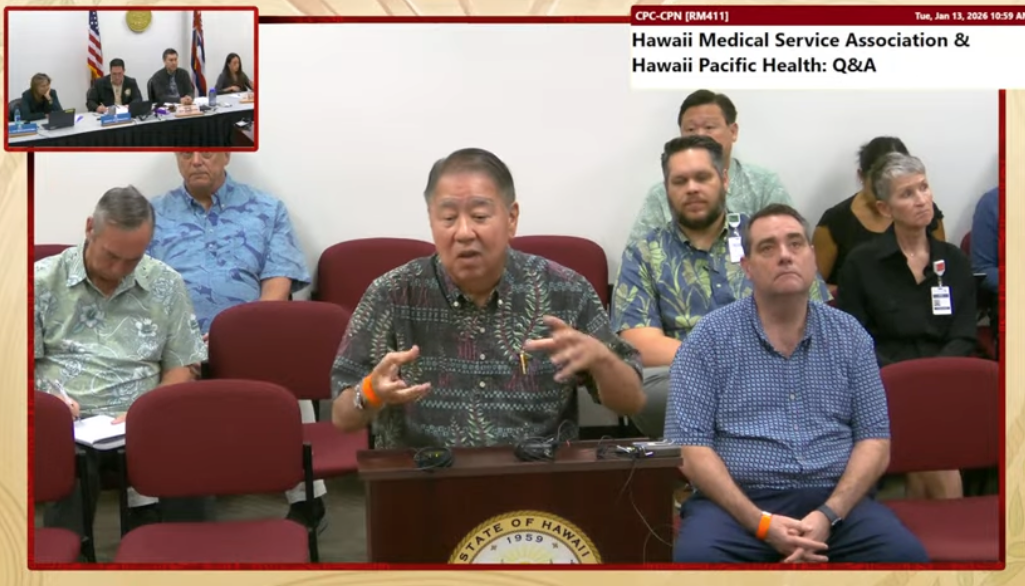
The proposed deeper integration between Hawaiʻi Pacific Health and the Hawaii Medical Service Association would intensify this dynamic. Vertical integration between insurers and hospital systems concentrates pricing power, reduces transparency, and squeezes independent providers out of the market.
This is not speculation. It is basic economics.
A large body of research shows that consolidation in health care markets consistently leads to higher prices, while promised improvements in quality or efficiency rarely materialize for patients. When competition decreases, prices rise, innovation slows, and service quality declines. Any efficiencies achieved by large systems are rarely passed on to consumers. Health care follows the same economic rules taught in introductory economics courses.
Ripple Effects Hit The Entire Economy
The harm does not stop with patients.
When health care costs rise and access shrinks, small businesses and the trades suffer. Electricians, plumbers, farmers, contractors and other small employers are legally required to provide or purchase health insurance. In a monopolized market, premiums rise faster than income, so small businesses are forced to cut staff, limit growth or close altogether. Independence becomes unaffordable. Independent operators and workers are pushed into corporate employment not by choice, but by necessity.
This is how consolidation in health care accelerates consolidation across the entire economy. Even large employers, including hotels, are increasingly strained by rising health care costs.
These outcomes are not accidental.
This consolidation did not happen in a vacuum. The Affordable Care Act adopted a market-driven framework first developed by the Heritage Foundation decades earlier: mandatory insurance purchase, employer and individual mandates, subsidized private plans, insurer-centric exchanges and managed competition.
While intended to expand coverage, this structure shifted health care away from a relational model — centered on the patient and their doctor — and toward a transactional subscription model, where the patient’s primary relationship is with an insurance plan and not his/her doctor.
Care is increasingly mediated by networks, formularies and prior authorizations. Control shifts upward, consolidation accelerates and local-led care weakens.
The same logic now appears across our economy. We are increasingly subscribers rather than owners, renters rather than homeowners, employees rather than independent operators and business owners. Control concentrates upward while local autonomy and resilience erode.
The Governor Can Act — Now
This is not a situation where leadership is powerless. The governor has real authority, particularly in the short term. While not every problem can be solved overnight, meaningful action can begin within months.
That includes imposing enforceable guardrails on health care consolidation; opening Hawaiʻi’s insurance market to real competition; ending “paper capacity” by requiring approved projects to be built; enforcing existing network adequacy laws; and aggressively pursuing a higher Medicare Geographic Practice Cost Index so physicians can afford to practice in Hawaiʻi — especially on the neighbor islands.
This is not an ideological argument. It is an outcomes-based one.
Maui’s health care system — like those on other neighbor islands — is failing to meet basic community needs. Consolidation has reduced choice. Certificate of Need has restricted supply. Vertical integration has shifted control away from patients, doctors, and small businesses. The lived experience by Maui residents makes this undeniable.
From national interview rounds, Gov. Josh Green has expressed a commitment to saving lives and improving health care. That commitment must now be reflected in urgent action here at home.
Health care consolidation is one of the most powerful drivers of rising health care costs.
What is at stake is not just health care, but the survival of Hawaiʻi’s families, private practitioners, tradespeople, and small businesses. More broadly, when we look at the core of our current political and economic realities and current events, what is truly at stake is a deeper issue: our sovereignty from complete concentrated control over our daily lives and means to make a living.
Health care consolidation is one of the most powerful drivers of rising health care costs — and, through those costs, a mechanism for consolidating control over the rest of our economy and trades, especially under current mandates imposed on employers and individuals. Private equity firms and large nonprofit and for-profit corporations have already decimated my profession. Now, alongside increasing overregulation of your own trade, they are exploiting the asymmetric and inescapable demand for health care to extend that same control to your trade and livelihood.
(And here in Hawaiʻi, shipping represents another major lever of economic control — but that is an op-ed for another day.)
What happens in health care does not stay in health care; it sends a tsunami through the affordability of every good and service we rely on. Affordability governs everything that follows: housing, food, safety, and, ultimately, whether people retain any real ownership over their own lives.

Sign up for our FREE morning newsletter and face each day more informed.
Source link
